
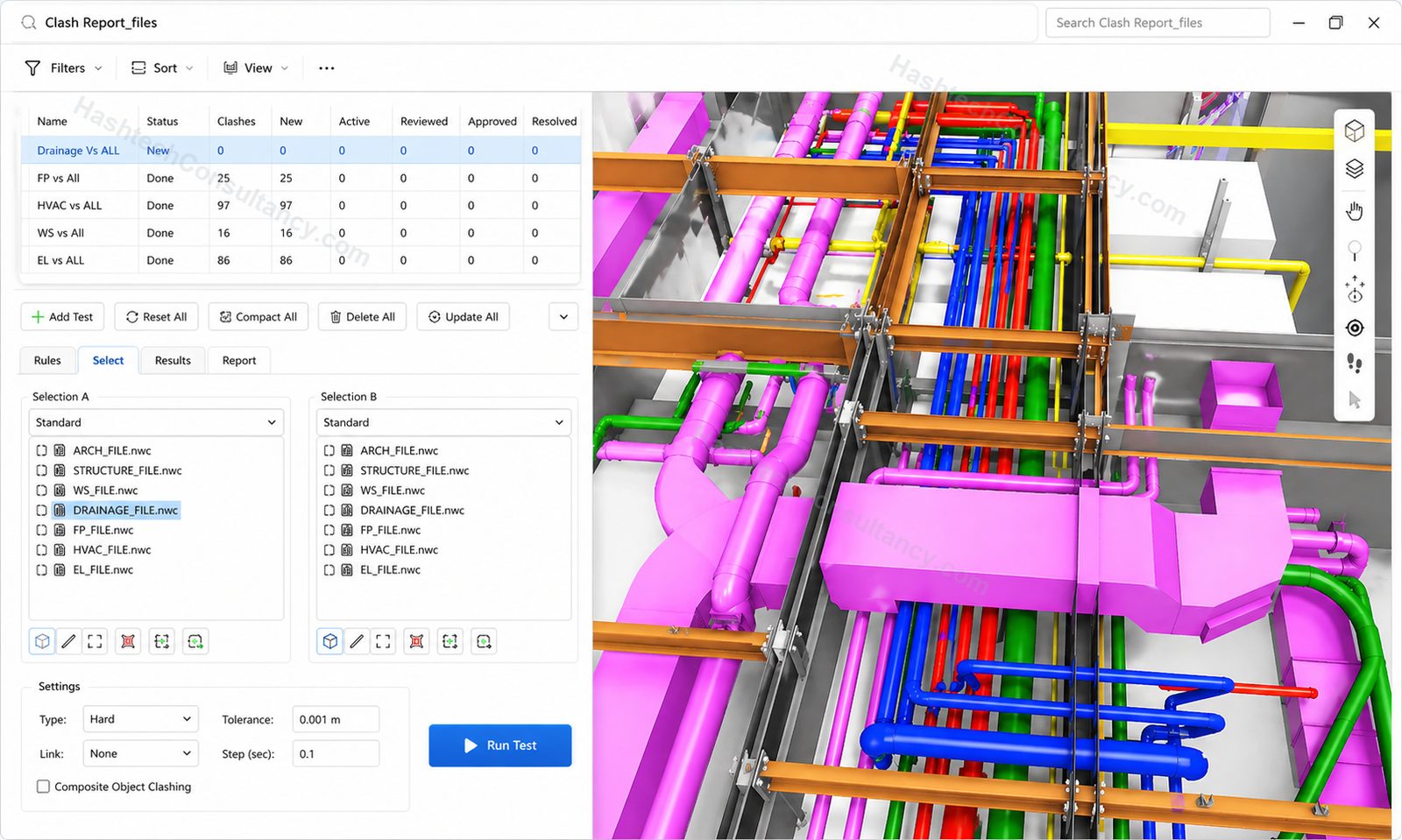
See the Problems Before They Become Site Issues
Construction clashes are often expensive to discover after installation has started.
We use Navisworks Manage and Revit to systematically review coordinated models and identify conflicts between architectural, structural and MEP systems. Each issue is assessed, documented and prioritised so project teams can focus on the problems that matter most.
What We Detect
Hard Clashes
Identify physical intersections where two or more building elements occupy the same space, such as ductwork passing through structural beams or pipework intersecting equipment.
Soft Clashes
Check required spatial tolerances around building elements, including service zones, maintenance areas, access requirements and installation clearances.
Clearance & Access Conflicts
Identify insufficient space around equipment, valves, panels, plant and other maintainable components to help ensure safe installation and future maintenance.
Workflow & Constructability Issues
Highlight coordination conditions that may not technically clash but could create difficulties during installation, sequencing or site execution.
Our Clash Detection Workflow
- 01
Model Preparation
Review and prepare discipline models before testing, checking model integrity, coordinates, levels, naming conventions and relevant project requirements.
- 02
Clash Test Setup
Configure clash tests based on project priorities, discipline interfaces, tolerances and required clearance zones.
- 03
Automated Detection
Run systematic clash tests using Navisworks Manage to identify intersections and spatial conflicts across the federated model.
- 04
Issue Classification
Group, filter and prioritise clashes to separate critical construction issues from duplicate, acceptable or low-priority findings.
- 05
Resolution
Coordinate with the relevant discipline and update the model or design to resolve identified conflicts.
- 06
Verification
Re-run clash tests after revisions to confirm that resolved issues no longer create conflicts.
From Clash Reports to Resolved Issues
A long list of clashes is not necessarily a successful coordination outcome.
Our approach focuses on actionable coordination rather than simply generating hundreds of clash points. We consolidate related clashes, identify their root causes and provide clear viewpoints and issue information so the responsible team can understand what is conflicting, where it occurs and what needs to change.
Clash Detection Deliverables
Clash Detection Reports
Structured reports showing identified conflicts and their current status.
Clash Viewpoints
Clear 3D viewpoints showing the exact location and nature of each issue.
Issue Registers
Track clashes from initial identification through review, assignment and resolution.
Federated Coordination Models
Combined discipline models used for comprehensive coordination testing.
Resolved Clash Reports
Updated reports confirming which issues have been addressed following model revisions.
Coordination Drawings
Where required, coordinated 2D documentation supporting the resolution and construction process.
Coordination Across Building Systems
Our clash detection workflow can be applied across multiple discipline interfaces:
- Architecture and structure
- Architecture and MEP
- Structure and MEP
- Mechanical and electrical
- Mechanical and plumbing
- MEP and fire protection
- MEP and specialist trades
This is particularly valuable in plant rooms, risers, ceiling voids, service corridors and other high-density areas where multiple systems compete for limited space.
Why Clash Detection Matters
Reduce Rework
Identify conflicts before materials and systems are installed.
Improve Constructability
Resolve spatial and access issues while changes are still relatively easy to make.
Protect Project Schedules
Reduce unexpected coordination problems during construction.
Improve Installation
Give site teams clearer and more reliable coordinated information.
Reduce Construction Risk
Address potential conflicts before they become costly field issues.
Software & Technical Capabilities
Primary Software
Navisworks Manage and Autodesk Revit.
Clash Types
Hard clashes, soft clashes, clearance clashes and access conflicts.
Coordination Outputs
Clash reports, 3D viewpoints, issue registers, federated models and resolution tracking.
Navisworks Clash Detection & BIM Coordination Services
Hashtech provides clash detection and resolution services for construction, engineering and BIM teams working across complex building projects. Using Navisworks Manage and Autodesk Revit, we identify conflicts between architectural, structural and MEP systems before they become construction problems.
Our workflow covers hard clashes, soft clashes, service clearances and access requirements. Identified issues are organised into actionable reports and viewpoints, allowing project teams to review, assign and resolve coordination problems efficiently.
Frequently asked questions
What is BIM clash detection?
BIM clash detection is the process of identifying conflicts between different building elements or disciplines within a digital construction model before those conflicts occur on site.
What is the difference between hard and soft clashes?
A hard clash occurs when two physical elements occupy the same space. A soft clash occurs when required clearance, access, maintenance or tolerance zones are not available.
Do you use Navisworks for clash detection?
Yes. Navisworks Manage is one of our primary tools for federating models, running clash tests, reviewing conflicts and producing coordination outputs.
Can you detect clashes between MEP systems?
Yes. We can test mechanical, electrical, plumbing and fire protection systems against each other as well as against architectural and structural elements.
Do you only provide clash reports?
No. Our scope can include the complete process from clash detection through issue classification, coordination and resolution verification.
Can you work with models from different disciplines?
Yes. Architectural, structural, MEP and specialist-trade models can be federated for multidisciplinary clash detection, provided the models are supplied in suitable formats and coordinate systems.
Find the conflicts before construction does.
Identify. Prioritise. Resolve. Verify.
We’ll reply within one working day with questions, or with a scope and fee.